Imagine travelling to an alternate timeline where everyone speaks your language.
You understand them, mostly, but something’s off. The accent throws you at first, then the vocabulary: familiar words are used in unfamiliar ways. You should understand everything, and somehow, you’re still lost.
That was me, moving to France in 2011, eight generations of French-Canadian on my father’s side. I just assumed we’d understand each other. We spoke the same language, didn’t we? It took a while to figure out that we did, just not quite the same version of it.
A French person landing in Quebec hears something that stops them cold — words they recognise but that sound old-fashioned, accents and terms from their grandparents’ era, rooted in 17th-century French spoken 400 years ago.
Thee instead of you.
Naught instead of nothing.
Hark instead of listen.
That’s Québec French to a Parisian ear — a linguistic time capsule from before the French colonies were cut off from France’s evolving language.
How Much Do French Canadians and Europeans Actually Understand Each Other?
I’ve watched it firsthand. My cousin Louis from downtown Montreal visited me in Montpellier a few years ago. He chatted up someone on the tram who smiled and nodded politely. Another time, a young boy just said, “Sorry, I don’t understand you.” A Parisian might catch most standard Quebec French. Drop them into the rural backwoods of Quebec or the streets of Montreal, where you’ll hear “joual,” the working-class street slang, and they’re lost.
My daughter Catherine, who has lived in France her whole life, has the same problem in reverse.
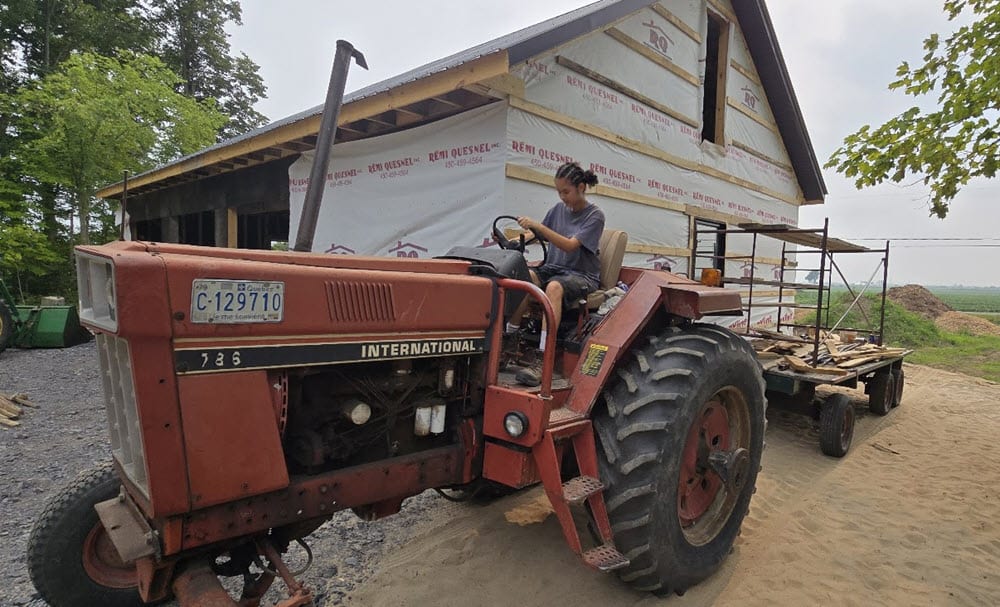
Every year, we visit my family in Montreal, and she can usually understand all the nuances of the Québécois language. But last summer, she spent the summer in St. Clet, a rural town an hour west of Montreal, near where my father is from, in Coteau Station. I sent her there to work with my cousin and his wife to help build a garage from the ground up. I was genuinely surprised at how little she could understand. She speaks differently now than my father and his father spoke.
Standard French to rural Quebec French is roughly what a CNN anchor accent is to a thick Mississippi delta drawl. And that’s before you hit the vocabulary, where a word you know means something completely different.
Quebec French vs France French
One of my friends in France once told me my French vocabulary was ‘cute’ because I still use old-fashioned French words like souliers for shoes instead of the more modern chaussures. Her grandmother was the only other person she knew who used that word. Grrr.
I’ve learned to adjust my vocabulary in France, but sometimes when I go back to visit my family in Montreal, I forget to switch back. Like the time I used the French term’ bains de bouche ‘for mouthwash instead of the Québécois’ rince-bouche’. My cousin couldn’t stop laughing because bains de bouche means mouth bath.

Words That Stayed in Quebec, But Vanished in Europe
Quebec French didn’t just deviate from France French, it also preserved older expressions that France itself used less and less over time.
KIDS OR TESTICLES?
In France, les gosses is a cute informal word for kids. In Quebec gosses is slang for testicles. I nearly choked the first time I heard another parent at my daughter’s school point at the schoolyard and coo about the “cute little gosses running around.” My brain was SCREAMING. All I could hear was “cute little TESTICLES running around.”
CORN OR INDIAN WHEAT?
Instead of maïs, Quebeckers say Blé d’Inde — literally “wheat of India.” When early French explorers arrived in North America, they were convinced they’d reached the Indies. They called the crop Indian wheat. The same explorers made the same geographical mistake with the people they encountered — hence “Indians.” France adopted maïs from Spanish. Quebec kept both errors.
CROOKED OR A MUSICAL NOTE?
Instead of tordu, Quebeckers say croche. In Montreal, a crooked painting is croche. In Paris, croche is an eighth note in music. Point at a crooked painting and they think you’re pointing at sheet music.
LATER OR SOON?
Instead of à bientôt, Quebeckers prefer to say à tantôt. In France? Sounds like your grandma talking.
LOCK IT OR BLOCK IT?
Instead of fermer la porte à clé, Quebeckers say barrer la porte. Normal in Quebec, but in France, barrer means to block or obstruct. Same phrase, different meaning. Three words versus five.
EMAIL OR ELECTRONIC MAIL?
Instead of mail, Quebeckers say courriel — a mashup of courrier and électronique, coined in the 90s by a linguist named André Clas. In France, no one uses it except on government sites. Just mail. Not e-mail. Mail.
France’s Weird English Word Borrowings
France has a reputation for calling Québécois French ‘peasant‑like’ and rustic because of the accent and old‑fashioned words — then turning around and filling its own speech with English loanwords like “shopping” or “weekend.”
The first time I went to a salon in France, the stylist asked if I wanted a brushing. I said sure. She started blow-drying my hair, and it blew my mind. Quebec uses séchage, from the French verb sécher, to dry.
There are quite a few English words used in France that have nothing to do with the original English meaning. A makeover is a relooking. A jog is footing. And un smoking has nothing to do with cigarettes — it’s a tuxedo.
My personal favourite: I once asked a gym instructor what the next class was. She said “Bow-dee poo-wah.” I had absolutely no idea what she was saying. She repeated it three times. Turns out the next class was called Body Power.
Why Does Quebec Force French on Stop Signs?

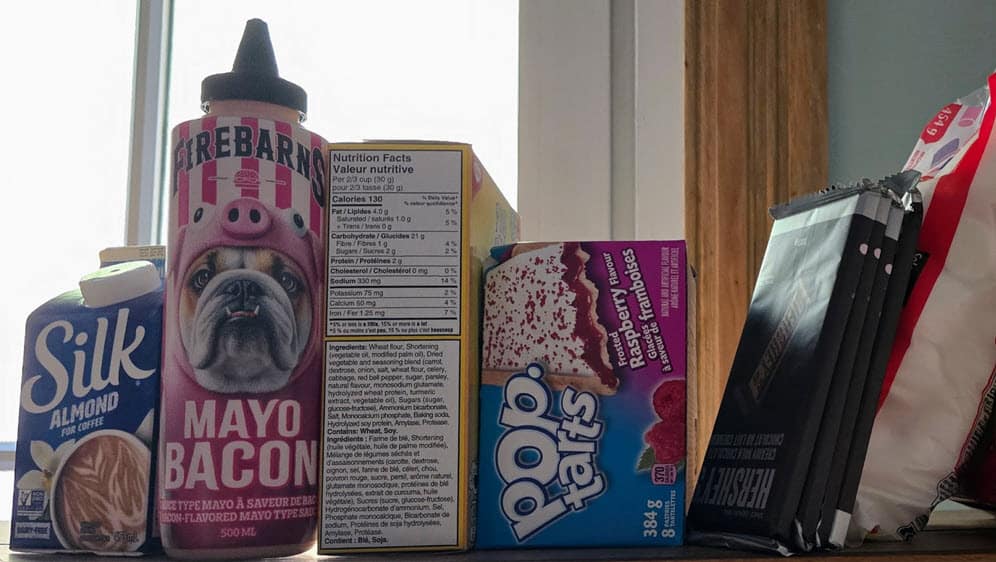
In Quebec, the French language doesn’t just survive. Laws exist to preserve and enforce it. Signs, menus, product packaging like cereal boxes — French has to be there, more prominent than the English. Even stop signs say arrêt. France uses Stop.
That’s Bill 101, passed in 1977, designed to push back against English encroachment. When French kept losing ground anyway, Quebec passed Bill 96 in 2022 and tightened the screws further.
Quebec fights an Anglophone continent to save French. France crushed its own regional tongues — Occitan, Breton, Alsatian — to impose Parisian French.
English Quebecers — about 10% of the population — aren’t always happy about these rules. Most kids must attend French public schools unless they meet strict exceptions to attend English ones. Government services outside Montreal run mostly in French only. Workplace rules require bosses to use French in meetings unless everyone present understands English. And when contracts are bilingual, the French version prevails legally regardless. All of it regulated, all of it enforced. “It’s absurd,” someone told me. “I just want to sign a contract, not a manifesto.”
Many Quebecers are genuinely glad about this. Not relieved. Elated. My aunt Huguette among them. Hah, take that, you anglophones!
How the British Conquest of 1763 Split the French Language in Two

When French settlers arrived in North America in the 1600s, they brought the French of ordinary people. Then the British conquered New France in 1763, and the link was cut.
France kept evolving toward Parisian norms because it had to. The Academy made Parisian French the standard in 1635, then the Revolutionaries and mass education drilled it into every classroom. Regional languages got ironed out — Occitan, Alsatian, Breton, once spoken across entire swaths of the country. Quebec escaped all of it.
Except the accents were harder to kill. When we first moved to France, we lived in Marseille, where everyone sounds like they’re speaking French with an Italian accent — the old Provençal underneath was too stubborn for Paris to stamp out. It sounds nothing like the French films I watched growing up.
In the 1600s, the French court pronounced moi as ‘mwoy‘ and toi as ‘twoy.’ Parisians eventually shifted to ‘mwa‘ and ‘twa.’ You can still hear moé and toé on the streets of Montreal, but it’s now working-class speech rather than standard.
Quebec kept moving too. Just not in the same direction. Isolated from Europe, Quebec skipped France’s linguistic trends and held on to many original sounds and words, then evolved on its own terms — absorbing Indigenous loanwords such as the Algonquin ouaouaron (bullfrog) and Kebec (Quebec), meaning “where the river narrows.” Quebec invented new words like dépanneur for a convenience store, from the verb dépanner (to get someone out of trouble)
English survival slang got Frenchified: to check became checker, to rush became rusher. A Québécois will conjugate English verbs directly into French sentences without thinking twice — something you almost never hear from other Francophones. “J’ai checké mes courriels.” “On a rushé pour arriver à l’heure.” French people in France would never.
France was shaped by different slang. The street French of Paris and Marseille layers in Arabic words for urban cool — wesh (yo/street greeting), kiffer (love it) — and verlan, slang that flips syllables: femme (woman) becomes meuf. The word verlan is itself verlan — l’envers (the reverse), flipped.
My daughter and son constantly toss these around. French parents nearby? Instant frowns of disapproval.
Quebec remembers what French used to sound like. France forgot it ever sounded any other way.
Quebec Wasn’t the Only One
My own accent is a smaller version of the same thing. Fifteen years of European French layered over Quebec French, no British conquest required. Just time and distance doing the same work.
Quebec isn’t the only French variety that got cut off and went its own way. When the British banished the Acadians from Nova Scotia in 1755, they scattered. Many ended up in Louisiana, where their French evolved into what we now call Cajun. New Brunswick, the only other province where French is official at the provincial level, developed its own Acadian French — softer consonants, a trilled r in older speakers, and a rhythm all its own.
And it’s not just French. Brazilian Portuguese still uses 16th-century grammar that disappeared in Portugal generations ago. Quebec kept much of the old French. Brazil kept much of the old Portuguese.
Latin didn’t turn into multiple romance languages like French, Spanish, Italian, and Portuguese because anyone planned it. It became those languages because people in different areas, isolated from one another, kept speaking their own versions until those versions stopped being the same language.

Why My French Accent Confuses People
I recognised the sound the first time I heard Christopher Walken—slightly off, like he was raised by parents who didn’t speak the language natively and absorbed all their small idiosyncrasies without knowing it.
My path didn’t help: Quebec French from eight generations on Dad’s side. English-only California years. My mother’s Thai accent layering over everything. Four years in Japan. Then European French on top.
After fifteen years surrounded by European French, that’s what my accent has become. Something hybrid, shifted in ways I didn’t plan and can’t fully control. It can also shift depending on who I’m talking to.
If Louis XIV walked into a diner in rural Quebec and into a Paris bistro, he’d be shocked by how much both languages have changed. But I’m convinced he’d feel more at home with the language’s sound in Quebec. That’s where my own voice sits now, too. European French layered over my Quebec roots. Ask for mayo at a Montpellier kebab shop, and they hear something ‘off.’ My dentist caught me saying broches for braces. Someone once guessed I was from Belgium. I nearly fell over.
My friend told me she loved the way I say “Tu sais,” which comes out more like “Tsay.” She said it was charming. I say it’s just the way I talk.
